
Oklahoma music history by county
Carter County
A documented county history drawn from newspapers, yearbooks, archival collections, programs and related evidence. The documented record is strongest for organized band activity through 1999; other musical traditions are included only where the underlying evidence supports them.
Historical overview
Carter County has one of the strongest documented school-band histories located in this county series. Ardmore’s instrumental-music history identifies 1926 as the beginning of band development in the public schools, when approximately twenty youths were organized to play pep and martial music. The program grew into a marching and concert organization and continued through successive directors. Carter County history excerpt (strong evidence)
Ardmore’s 1961 and 1962 yearbooks document Albert Fitzgerrel as band director, Raymond Gabbard as instrumental assistant, a substantial “Pride of AHS” program, pep-band activity, district and state recognition, and superior ratings. The 1962 volume reports superior ratings in field marching and inspection, first place in Class BB street marching, and third place in Sweepstakes competition with thirty bands. (strong evidence) Healdton’s 1964 and 1972 yearbooks document band, stage band, All-District and All-State participation, a drum major, twirlers, and superior district and state results. (strong evidence)
The county’s verified record demonstrates sustained school-band development, public performance, contest culture, and potential lifelong-musician pathways. The adult civic-band record and complete 1980s and 1990s chronology remain incomplete. (moderate evidence)
Historical images
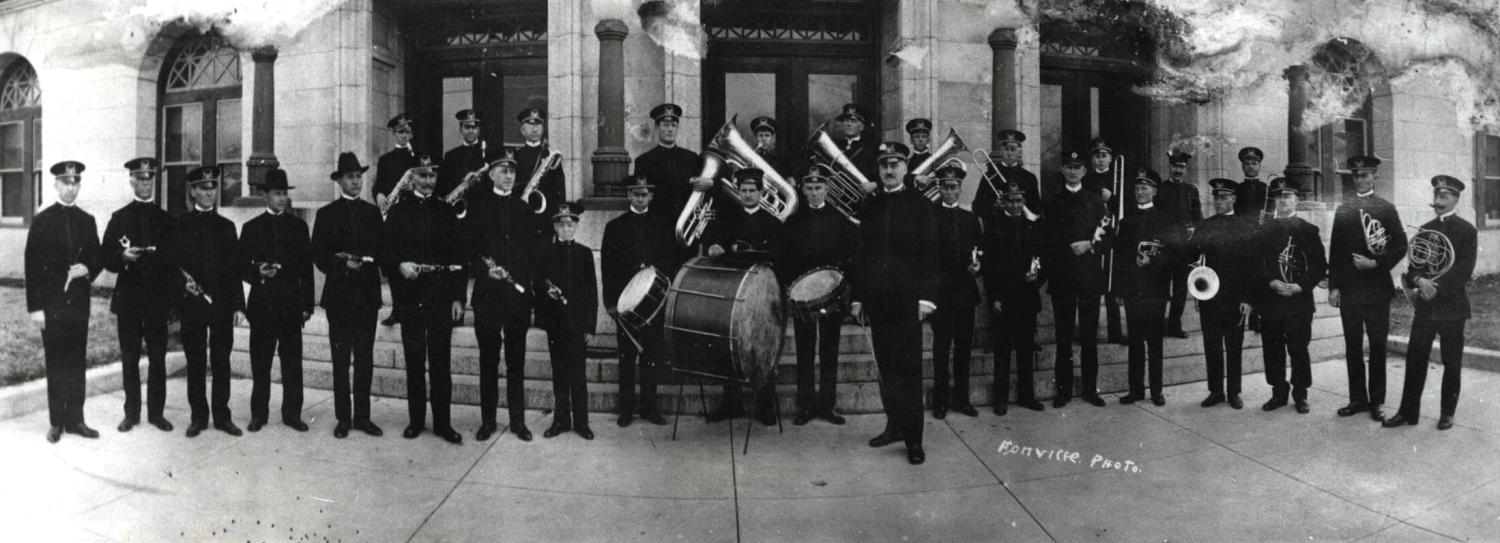
Ardmore Public Library, via The Gateway to Oklahoma History. View the documented record and full attribution.
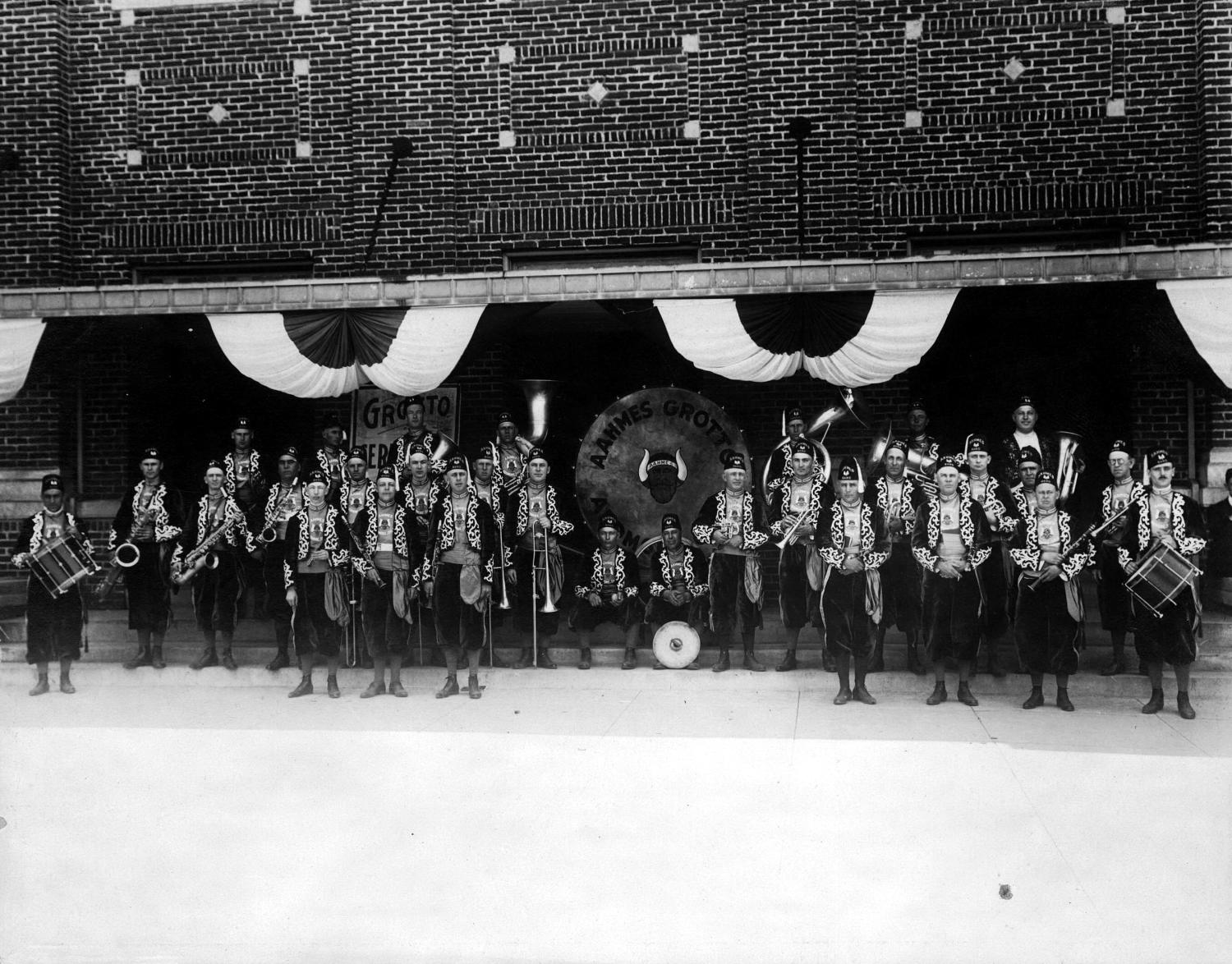
Ardmore Public Library, via The Gateway to Oklahoma History. View the documented record and full attribution.
Community and institutional inventory
Ardmore is the county seat and the principal documented band center. Healdton is the second major school-band center in the evidence reviewed. Lone Grove, Wilson, Ringling, Springer, Fox, Gene Autry, Ratliff City, and rural schools require separate yearbook and newspaper searches.
Ardmore’s theaters, schools, football facilities, public streets, and civic event spaces form a likely performance network. The Carter County history excerpt also shows that school band was connected to pep, martial, parade, football, rodeo, Armed Forces, Christmas, and homecoming events. (strong evidence)
Chronology
- 1907: Sol Lowenstein arrives in Ardmore and begins developing instrumental music in the public schools, initially through strings and orchestra. Carter County history excerpt
- 1926: Ardmore band development begins with about twenty youths organized for pep and martial music. (strong evidence)
- 1957: The Carter County history account describes Ardmore’s band as a marching and concert organization and identifies a succession of directors including Paul Enix, Raymond Gabbard, and Albert H. Fitzgerrel. (medium-high)
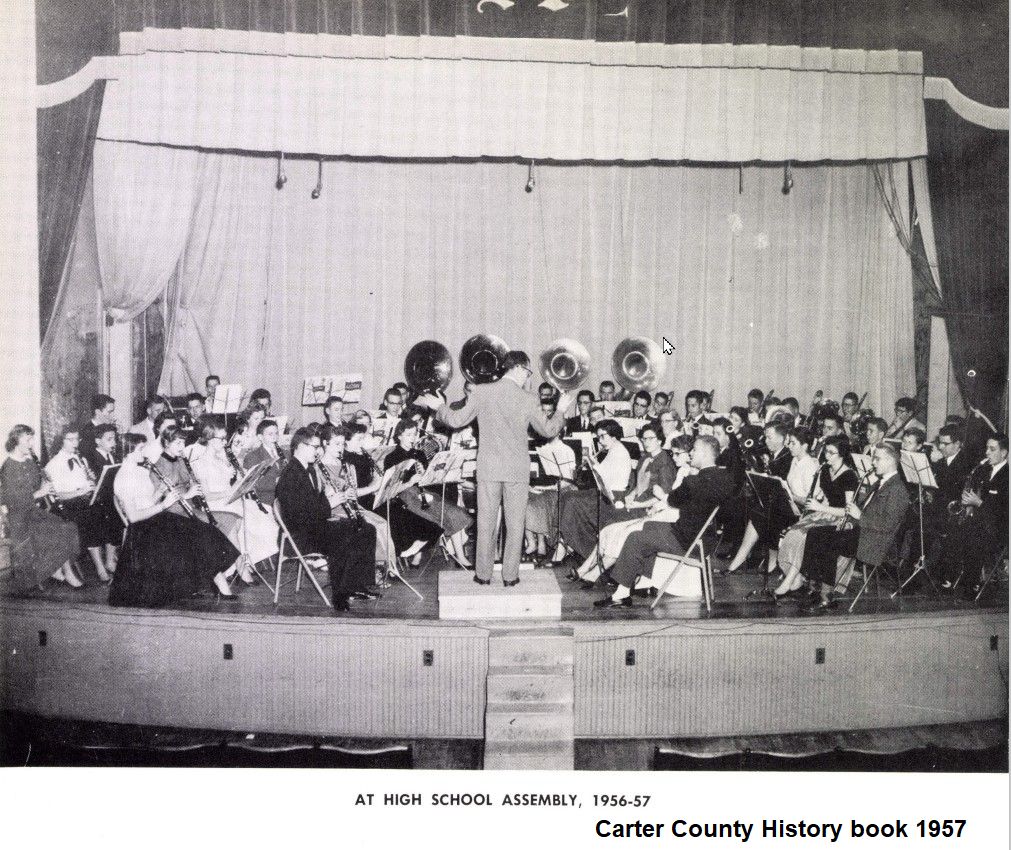
- 1956: A photograph titled Ardmore High Assembly is preserved by the local Oklahoma History website and is included as a research image. Photograph
- 1961: Ardmore High School’s yearbook identifies Albert Fitzgerrel as director, Raymond Gabbard as instrumental assistant, and Jimmy Downey as drum major. (strong evidence)
- 1962: Ardmore’s band receives superior field-marching and inspection ratings, first place in Class BB street marching, and third place in Sweepstakes against thirty bands. (strong evidence)
- 1964: Healdton High School yearbook evidence documents band activity, All-District participation, and a drum major. (strong evidence)
- 1972: Healdton documents band, stage band, All-District and All-State participation, twirlers, band royalty, and superior district and state results. (strong evidence)
- 1980s and 1990s: No complete countywide chronology was verified in the sources reviewed. (moderate evidence)
Ardmore’s beginning of instrumental band music
The Carter County history excerpt states that Sol Lowenstein came to Ardmore in 1907 from the Boston Conservatory of Music and began a public-school music program. It says the early work began with strings and orchestra, then identifies 1926 as the beginning of band development with approximately twenty youths organized for pep and martial music. The organization grew into a group that could march well and play concerts. (strong evidence)
This account is especially important because it identifies a transition from school music instruction to a durable wind and marching-band institution. It also frames the band as both a performance organization and a community-service organization.
Ardmore directors and institutional development
The same history account names Paul Enix as Lowenstein’s successor, followed by Raymond Gabbard after Enix entered military service, and Albert H. Fitzgerrel after Gabbard left the school system for private business. The 1961 and 1962 yearbooks independently confirm Fitzgerrel as instrumental-music and band director and Gabbard as instrumental assistant. (strong evidence)
The director succession provides a strong basis for a fuller Ardmore chronology. The next step is to verify the precise service years, credentials, and adult musical activities of each director through school-board records, newspapers, alumni publications, and Oklahoma music-educator records.
Ardmore High School, 1961
The 1961 Ardmore High School yearbook identifies the Ardmore High School Band, Albert Fitzgerrel as director, Raymond Gabbard as instrumental assistant, and Jimmy Downey as drum major. It provides a substantial band photograph and student roster. The yearbook also states that music groups provided entertainment for the school and community. 1961 Ardmore High School yearbook
The visible roster includes Carolyn Kinkade, Doug Fitzgerrel, Richard Knapp, Gary Adams, Ruth Ann Hicks, Donna Whitehurst, Mary Helen Knight, Peggy Lamer, Mary Mike Landrum, Jimmy McDermitt, Bennett Mannahan, John Earl Maxwell, Donna Powers, Deanna Proctor, Lonnie Scrugham, Mark Selvidge, Robert Shelton, Gary Sims, Charles Smith, Tommie Lee Smith, Judy Varnell, Stephen White, Johala Woodrow, and others. The names require page-image verification before public indexing. (strong evidence)
Ardmore High School, 1962
The 1962 Ardmore High School yearbook provides the clearest Ardmore contest record. It states that the band received superior ratings in field marching and inspection at the state contest in Chickasha, placed first in Class BB street marching, and placed third in Sweepstakes competition with thirty bands. It identifies Albert Fitzgerrel as band director and Raymond Gabbard as instrumental assistant. (strong evidence)
The Pep Band consisted of fifteen members and played an important role in pep assemblies and basketball games. The yearbook identifies David Hopper as drum major and Linda Miller as a twirler. 1962 Ardmore High School yearbook
Healdton High School, 1964
The 1964 Healdton High School yearbook documents a band program with students participating across multiple years. Richard McCoy Dickinson is identified as a band member, drum major, All-State participant, band-clinic participant, and participant in superior district and state events. Roland Lynn Cowperthwaite is identified with Band, All-District, and All-State activity. (strong evidence)
The yearbook also identifies Harvey Imbeau under Band in the faculty or activity listing. The exact position should be checked against the page image before calling him director. 1964 Healdton High School yearbook
Healdton High School, 1972
The 1972 Healdton High School yearbook documents sixth and seventh grade band, elementary band, and high school band under David VanDeWalker. This is direct evidence of a multi-level school pipeline. (strong evidence)
Student records document Band, Stage Band, All-District Band, All-State, superior district and state results, band president, band secretary, band queen, twirlers, head twirler, and a superior solo. Named leads include Jimmie Dean Hill, Cynthia Joyce Holder, Leroy Terry Keck, Cynthia Kay Loyd, Linda Jo Miller, Carol Ann Mauldin, and other students. 1972 Healdton High School yearbook
Lone Grove, Wilson, Ringling, and other schools
No qualifying band record was verified in the sources reviewed for Lone Grove, Wilson, Ringling, Springer, Fox, Gene Autry, Ratliff City, or the smaller Carter County communities. The absence of a verified record does not demonstrate the absence of a band. Local weekly newspapers, school annuals, church and veterans records, and family photographs should be searched.
The Lone Grove Ledger is a promising newspaper lead because local history references show that it carried community news in the early twentieth century. A full page-image search is still needed for band, parade, school, and civic music notices.
Countywide civic, military, and public-performance network
The Ardmore history account states that the band performed for rodeos, Armed Forces events, Christmas, homecoming, and other parades, as well as football half-time displays, school assemblies, midwinter concerts, and coronation concerts. It also participated in district and state music contests. (strong evidence)
This is a substantial public-performance network, but it remains school-centered in the sources reviewed. No separately named adult civic or veterans band was verified. The Armed Forces reference may offer a bridge to military and veterans events, but it should not be reclassified as a military band without a source identifying the ensemble.
Mature school-band program
Ardmore’s program had developed into a large and publicly visible organization by the late 1950s and early 1960s. Its functions included pep and martial music, marching, concerts, football, parades, rodeos, Armed Forces events, school assemblies, coronations, and contests. Healdton’s 1972 program added elementary, junior-high, high-school, stage-band, All-District, All-State, and superior-rating pathways. (strong evidence)
Together these records show how Carter County schools used band as a longitudinal educational system and as a public institution.
s and 1990s continuity
The sources reviewed do not establish a complete 1980s or 1990s chronology for Ardmore, Healdton, Lone Grove, Wilson, or other Carter County schools. I do not know whether the documented programs continued under the same names, changed directors, merged with other ensembles, or produced adult community bands.
Priority records include Ardmore and Healdton yearbooks from 1975, 1980, 1985, 1990, and 1995, followed by state contest programs and local newspaper searches.
Directors, instructors, managers, and institutional leaders
- Sol Lowenstein, Ardmore instrumental-music organizer beginning in 1907. (strong evidence)
- Paul Enix, Ardmore band director after Lowenstein. (medium-high)
- Raymond Gabbard, Ardmore music director and later instrumental assistant. (strong evidence)
- Albert H. Fitzgerrel, Ardmore band and instrumental-music director in 1961 and 1962. (strong evidence)
- David VanDeWalker, Healdton elementary, junior-high, and high-school band instructor in 1972. (strong evidence)
- Harvey Imbeau, associated with Healdton band in 1964; exact title unresolved. (moderate evidence)
Musicians, rosters, and family-name leads
The Ardmore yearbooks provide named band rosters, including Jimmy Downey, identified as drum major in 1961 and described as leading the band. The 1962 yearbook adds David Hopper as drum major and Linda Miller as twirler. Healdton’s yearbooks identify Richard McCoy Dickinson, Roland Lynn Cowperthwaite, Jimmie Dean Hill, Cynthia Joyce Holder, Leroy Terry Keck, Cynthia Kay Loyd, Linda Jo Miller, and Carol Ann Mauldin among band and stage-band participants.
These names are leads for oral history, family research, and adult continuation. They should be verified from page images and later records before publication.
Performances, festivals and public events
Verified events include Ardmore pep and martial performances, football half-time displays, rodeos, Armed Forces events, Christmas, homecoming and other parades, school assemblies, midwinter and coronation concerts, district and state contests, the 1962 state contest in Chickasha, and Healdton’s superior district and state activity. (strong evidence)
The most clearly documented ratings are Ardmore’s 1962 superior field-marching and inspection ratings, first place in Class BB street marching, and third place in Sweepstakes among thirty bands. Healdton’s 1964 and 1972 yearbooks provide additional superior and All-District evidence.
Lifelong amateur musicianship interpretation
Carter County’s record strongly supports the project’s central thesis. Ardmore participants encountered sustained school instruction, repeated performance, marching and concert roles, peer leadership, contest goals, public service events, and a visible community identity. Healdton added a multi-level pipeline from elementary band through high school, stage band, All-District, All-State, solo, and superior-rating experiences. (strong evidence)
The records document school participation but not adult continuation. Former Ardmore and Healdton musicians should be asked whether they continued playing, joined church or civic bands, taught younger musicians, performed at veterans events, or returned to music later in life.
Photographs, clippings and documentary evidence
Photographs and documents
The archived source material preserves OCR and metadata for Ardmore yearbooks from 1961 and 1962 and Healdton yearbooks from 1964 and 1972. It also preserves a research copy of the 1956 Ardmore High Assembly photograph linked from the Carter County history page.
The 1956 image and 1961 and 1962 yearbook pages are strong candidates for the Oklahoma Band History website because they show band identity, leadership, public performance, and school-community connection. Rights and credit requirements should be checked before public display.
Related records
Historical evidence documents activity found in the sources; it does not by itself prove continuous operation. Similar names are not merged unless continuity is supported.