
Oklahoma music history by county
Garfield County
A documented county history drawn from newspapers, yearbooks, archival collections, programs and related evidence. The documented record is strongest for organized band activity through 1999; other musical traditions are included only where the underlying evidence supports them.
Historical overview
Garfield County has strongly documented evidence of a substantial Enid instrumental tradition. The approximately 1935 and 1945 parade photographs establish public marching-band activity, while the 1964 Enid High yearbook documents a multi-ensemble program under Eugene Griffin with marching, concert, symphonic, percussion, stage, and junior-high bands; civic performances; All-State participation; major festival hosting; and contest activity. Earlier Enid history and activity outside Enid remain incompletely documented.
Uncertain or not found
- No pre-1935 Garfield County band record was directly verified.
- The identity of the band in the approximately 1935 Enid photograph is unknown.
- The full name and school represented by the 1945 “P” School Marching Band were not found.
- No complete Enid High roster or contest-rating sheets were recovered.
- No separately named adult civic, municipal, veterans, or military band was verified.
- No directly verified pre-2000 band record was recovered for the other searched county communities.
Historical images
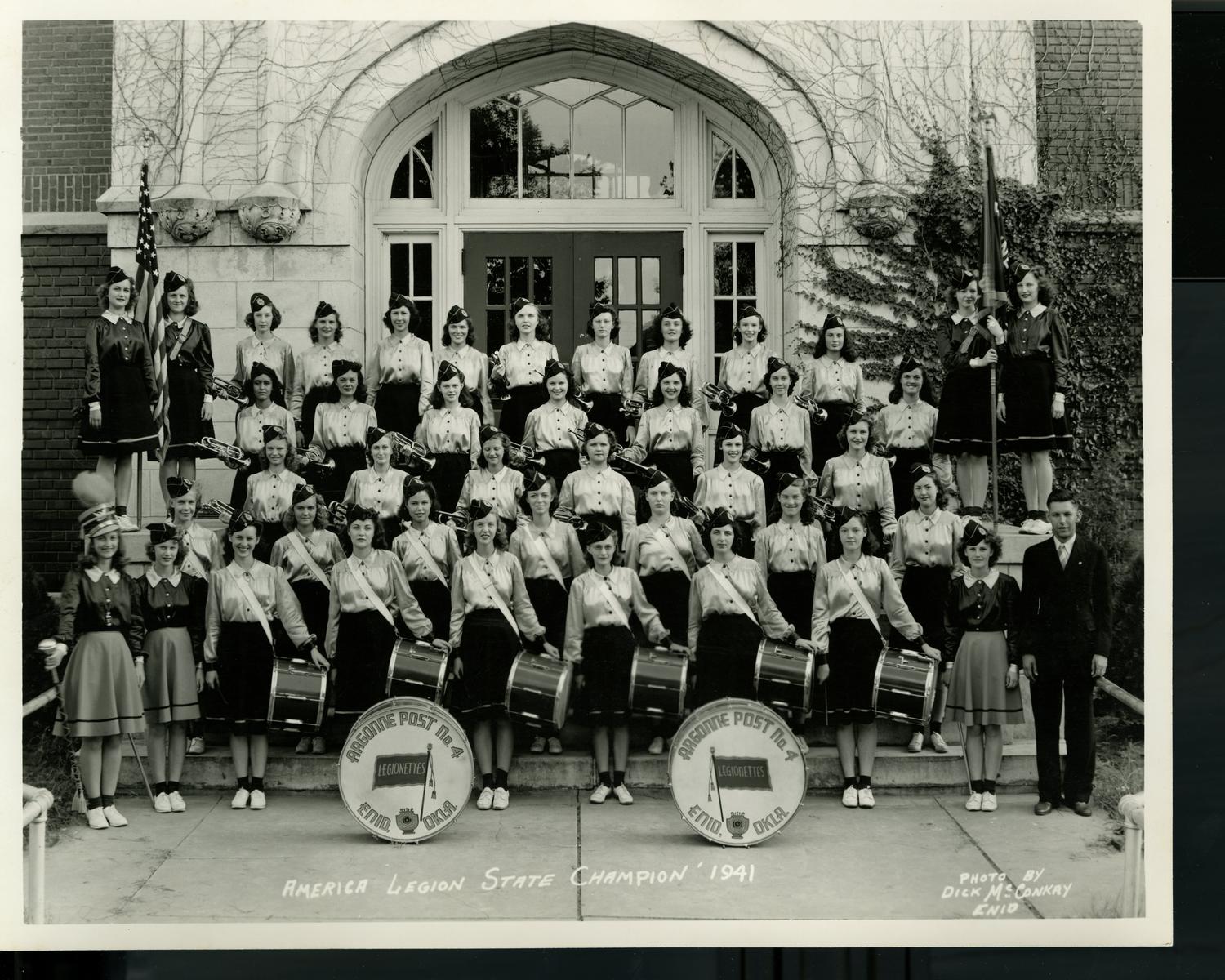
Published-media asset with source attribution retained on the linked record. View the documented record and full attribution.
Earliest documented activity
The earliest directly verified qualifying evidence located in the sources reviewed is an approximately 1935 photograph of a marching band in an Enid parade. A second Gateway photograph documents the “P” School Marching Band at the September 16, 1945 Cherokee Strip Parade in Enid. The 1964 yearbook provides the strongest fully inspectable written record. Evidence strength: strong.
Enid parade band, approximately 1935
The William Edson Photograph Collection contains a photograph described as “Parade, Enid, Oklahoma,” with a marching band and Evans Drug in the background. The date is approximately 1935, and the place metadata identifies Enid, Garfield County. The band is not named in the item record. Evidence strength: strong for the Enid parade and band image; low for the band's identity.
Cherokee Strip Parade
The Cherokee Strip Regional Heritage Center identifies a September 16, 1945 photograph of the 52nd Cherokee Strip Parade in Enid with the “P” School Marching Band. This is direct evidence of organized marching-band participation in a major county event. The record does not identify the school's full name, director, or members. Evidence strength: strong.
Enid High School, 1963-1964
The 1964 Enid High yearbook states that the band was among the school's most visible public organizations. It describes football halftime performances, precision marching, parade appearances, travel to concerts and contests, local civic-club performances, and All-State representation in Norman. Evidence strength: strong.
Enid High ensemble structure
The yearbook documents multiple related ensembles: marching band, concert band, symphonic band, percussion ensemble, stage or dance band, and three junior-high bands. It also identifies instrumental solo, ensemble, and parade-contest activity. This is unusually strong evidence of a multi-level school instrumental system. Evidence strength: strong.
Eugene Griffin and band leadership
The yearbook identifies Eugene Griffin as the experienced leader of the Enid High band and labels him as sponsor in the band photograph caption. A faculty listing identifies Eugene Griffin with music education and band and orchestra responsibilities. Evidence strength: strong.
Performances and venues
The Enid High band performed at football games, basketball games, local civic-club meetings, concerts, parades, statewide contests, All-State events in Norman, and the annual Enid Tri-Music Festival. The 1964 yearbook describes the downtown square as a festival setting and documents the school's practice field as a regular rehearsal location. Evidence strength: strong.
Enid Tri-Music Festival
The 1964 yearbook says Enid hosted approximately 11,000 instrumentalists, percussionists, vocalists, and dancers from across the nation at the annual Tri-Music Festival on April 30 and May 1-2. Bands competed in marching, concert, ensemble, solo, and parade events, with judges including Benny Goodman and Joe Morello. This places Garfield County within a major regional and national school-music network. Evidence strength: strong for the yearbook account.
Competitions and ratings
The yearbook states that Enid's band earned top honors in all fields in the festival context, although it was not eligible for the sweepstakes. It documents marching, concert, ensemble, solo, parade, and statewide contest participation. Exact rating sheets and the full contest chronology were not recovered. Evidence strength: strong for participation and the yearbook's summary; medium for the precise scope of “top honors.”
Instrumental personnel
The yearbook lists numerous student instrumentalists and activity roles, including band officers, All-State participants, stage-band members, and students identified with specific instruments. The OCR recovers names such as Stephen Arnold, William A. Arnold, Dan Haney, John Harvey, Charles James, Sherry Phillips, and others, but a page-image check is required before treating this as a complete or normalized roster. Evidence strength: strong for the existence of the roster; medium for OCR-derived names.
School continuity
The 1964 program links high school and junior-high bands and shows a progression from marching and concert participation to All-State, stage-band, percussion, solo, and ensemble work. This provides direct evidence of a pipeline through which young instrumentalists could remain active in organized music. Evidence strength: strong.
Phillips University
Gateway records a photograph titled “Band at Phillips University,” an important lead for Enid's college-level instrumental history. The item was not fully inspected during the sources reviewed because the Gateway page timed out. It should be reviewed and added to the county chronology after confirming date, ensemble identity, and image rights. Evidence strength: limited to medium.
Other Garfield County communities
No directly verified pre-2000 band record was recovered in the sources reviewed for Garber, Covington, Drummond, Waukomis, Hunter, Carrier, or Kremlin. This is an incomplete-search result, not evidence that those communities lacked bands. Evidence strength: limited.
Civic and community bands
No separately named adult municipal or civic band was verified. The Enid High band performed for local civic clubs and public events, but those appearances do not establish a separate adult community ensemble. Evidence strength: moderate.
Photographs, clippings and documentary evidence
Photographs and documents
The two strongest visual records are the approximately 1935 Enid parade photograph and the September 16, 1945 Cherokee Strip Parade photograph. The 1964 yearbook adds visual pages for the Enid High band, its leadership, marching activity, ensemble structure, and student musicians. Rights and reuse requirements must be checked before publication. Evidence strength: strong.
Sources and evidence
Links and citations below come from the underlying county research. Repository descriptions and access conditions remain controlling for reuse.
Newspapers and documentary evidence
The Gateway to Oklahoma History preserves Garfield County newspaper, photograph, and institutional records. The Cherokee Strip Regional Heritage Center collection is especially important for Enid parade photographs. Internet Archive provides downloadable Enid High School yearbooks, while commercial yearbook indexes identify broader Garfield County school holdings. Evidence strength: strong.
Sources: 1964 Enid High School yearbook, Enid yearbook collection, 1945 Cherokee Strip Parade photograph, approximately 1935 Enid parade photograph, Band at Phillips University
Related records
Historical evidence documents activity found in the sources; it does not by itself prove continuous operation. Similar names are not merged unless continuity is supported.