
Oklahoma music history by county
Ottawa County
A documented county history drawn from newspapers, yearbooks, archival collections, programs and related evidence. The documented record is strongest for organized band activity through 1999; other musical traditions are included only where the underlying evidence supports them.
Historical overview
The current search did not verify a complete named pre-2000 Ottawa County band chronology. (strong evidence) It did establish a substantial research base: early local newspapers, Miami’s civic and theatrical infrastructure, the long-running Miami college site, and a significant instrumental-music educator who grew up in Miami. (strong evidence) Edwin Paul Enix graduated from Miami High School in 1933 and later directed school, college, military, and community instrumental programs in Oklahoma. (moderate evidence) His biography is a strong county musician lead, but it does not by itself prove the identity or chronology of a Miami, Afton, Picher, or NEO band.
Historical images
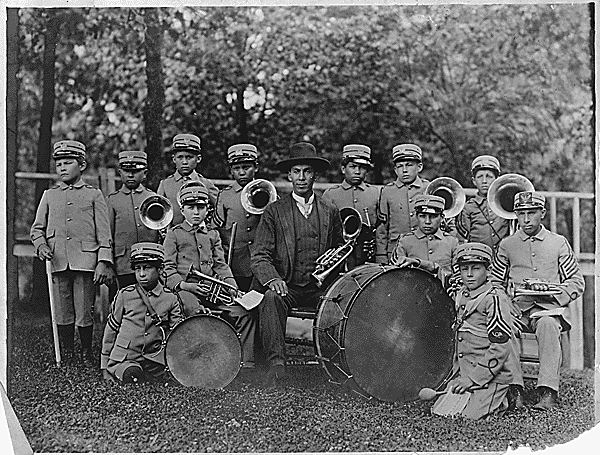
National Archives image used in the approved Oklahoma Band History media library. View the documented record and full attribution.
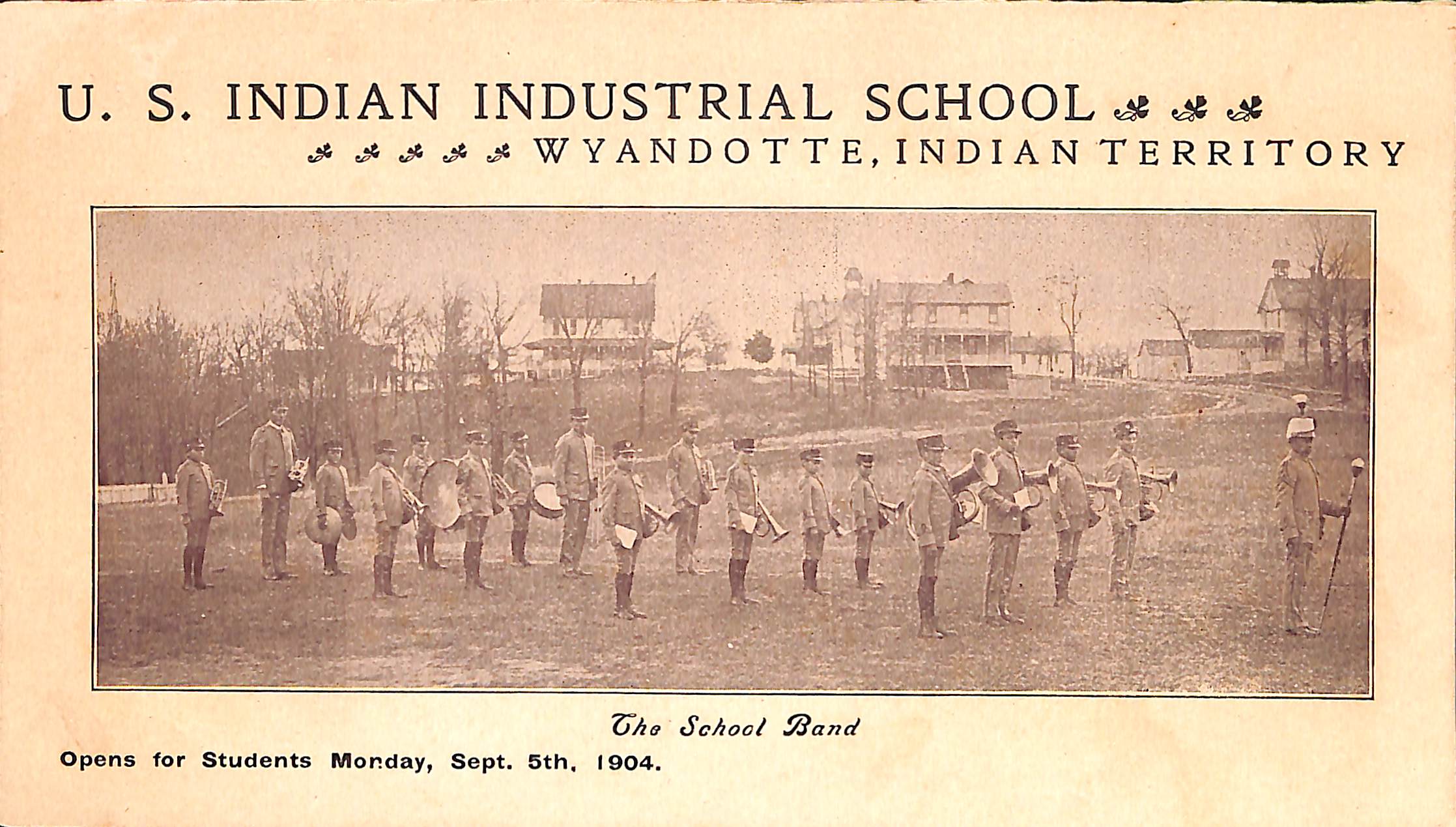
National Archives image used in the approved Oklahoma Band History media library. View the documented record and full attribution.
Band and ensemble inventory
| Ensemble or lead | Place | Date | Status |
|---|---|---|---|
| Miami High School band, unidentified in the sources reviewed | Miami | pre-2000 | Possible lead (limited evidence) |
| NEO/School of Mines band, unidentified in the sources reviewed | Miami | 1919-1999 | Institutional continuity lead (limited evidence) |
| E. Paul Enix instrumental-music career | Miami origin | 1933 onward | Verified person, not a county band (high/medium) |
| Afton, Picher, Commerce, Fairland, Wyandotte, or Quapaw bands | County communities | pre-2000 | Not verified in the sources reviewed (limited evidence) |
Bands and ensembles
No complete band profile with a confirmed name, director, roster, date range, and Ottawa County location was verified in the sources reviewed. (strong evidence) Miami High School and NEO yearbooks are the most promising direct leads. (moderate evidence)
Chronology
- 1895: The Afton Climax begins its historical run; Gateway holdings include 1905-1908 issues.
(strong evidence) - 1907-1911: Ottawa County Beacon published at Wyandotte.
(strong evidence) - 1919: Miami School of Mines established by state legislation.
(strong evidence) - 1929: Coleman Theatre opens in Miami with 1,600 seats.
(strong evidence) - 1933: Edwin Paul Enix graduates from Miami High School.
(strong evidence) - 1943: Miami School of Mines is renamed Northeastern Oklahoma A&M College.
(strong evidence) - 1946: Enix directs the 639th Army Air Corps Band after military service.
(strong evidence) - 1948: Miami VFW post opens, providing a possible veterans-music research context.
(moderate evidence) - 1950: NEO Viking yearbook is available for page-level review.
(strong evidence) - 1953: Miami High Miamian yearbook is available for page-level review.
(strong evidence) - 1989: City of Miami acquires Coleman Theatre.
(strong evidence)
People Index
- Edwin Paul Enix, Miami High graduate, instrumental-music educator and military-band director.
(strong evidence) - James B. A. Robertson, governor who signed the 1919 legislation creating Miami School of Mines.
(strong evidence)
Directors and bandmasters
No Ottawa County-based pre-2000 director was confirmed in the sources reviewed. Edwin Paul Enix should be pursued as a Miami-origin educator whose later career included band direction. (moderate evidence)
Schools and music education
Miami High School is documented as Enix’s school and has a surviving 1953 yearbook record. (strong evidence) The 1950 NEO Viking yearbook provides a comparable college source lead. (strong evidence) Band pages, rosters, and director names remain to be extracted from those volumes. (moderate evidence)
Civic and community bands
No named municipal or civic band was verified. Miami’s semi-centennial parade in 1941 drew approximately 30,000 attendees, but the available account does not identify a band. (moderate evidence)
Military, Veterans, and Fraternal Music
Enix’s direction of the 639th Army Air Corps Band in 1946 is verified military-band evidence tied to a Miami-born or Miami-raised musician. (strong evidence) The 1948 Miami VFW context is a follow-up lead, not proof of a local veterans band. (limited evidence)
African American, Indigenous, and Other Community Music
No qualifying Ottawa County ensemble in these categories was verified in the sources reviewed. This is an archive gap, not evidence of absence. (moderate evidence)
Women, Girls, and Youth Ensembles
No named Ottawa County women’s, girls’, or youth band was verified. Miami High and NEO yearbooks should be searched for these categories. (moderate evidence)
Performances, festivals and public events
Miami’s 1941 semi-centennial parade is verified as a major civic event, though the available source does not identify its musical participants. (moderate evidence) Coleman Theatre’s long live-entertainment history makes it a likely venue for future program and newspaper searches. (moderate evidence) No contest result or band festival roster was confirmed.
Venues and Music Infrastructure
The Coleman Theatre opened in Miami on April 18, 1929, with 1,600 seats and hosted live entertainment and orchestral presentations. (strong evidence) Miami’s railroad and trolley network, including a connection toward Picher, provides useful historical mobility context for county performances. (moderate evidence)
Newspapers and documentary evidence
The key newspaper sources are the Afton Climax, Ottawa County Beacon, Afton American, and Miami-area newspapers in the Oklahoma Digital Newspaper Program. (strong evidence) The 1908 Ottawa County Beacon issue is digitized as a 16-page primary source. (strong evidence) Yearbook leads include Miami High’s 1953 Miamian and NEO’s 1950 Viking.
Source quality and limitations
Primary digitized newspapers, institutional histories, yearbook records, and venue histories support the strongly documented infrastructure findings. (strong evidence) The Enix obituary/memorial is a strong biographical source, but it is secondary for county ensemble history. (moderate evidence) Search-result snippets and unreviewed yearbook indexes are leads only. (limited evidence)
Historical summary
Ottawa County has a strong documentary foundation but requires deeper page-level extraction before a reliable band chronology can be written. (strong evidence) The most important confirmed person lead is E. Paul Enix, whose Miami High background connects Ottawa County to Oklahoma’s broader instrumental-music and military-band history. (strong evidence) The next research stage should center on Miami and NEO yearbooks and systematic newspaper-page review.
Uncertain or not found
No complete named pre-2000 Ottawa County band, local director roster, band photograph, contest record, or continuous chronology was verified in this sources reviewed. The absence of a result should be treated as an archive and indexing limitation, not proof that no such ensembles existed.
Photographs, clippings and documentary evidence
Photographs and documents
No qualifying Ottawa County band photograph was verified for inclusion in this current source material. Miami High and NEO yearbooks are the principal visual-record leads. (moderate evidence)
Sources and evidence
Links and citations below come from the underlying county research. Repository descriptions and access conditions remain controlling for reuse.
Selected Sources
- E. Paul Enix memorial and biography
- Encyclopedia of Oklahoma History: Northeastern Oklahoma A&M College
- Afton Climax, Gateway newspaper collection
- Ottawa County Beacon, Gateway newspaper collection
- Ottawa County Beacon, May 23, 1908 issue
- Afton American dates
- Miami High School Miamian, 1953 yearbook lead
- NEO Viking, 1950 yearbook lead
- Coleman Theatre, Miami
- Miami History, 1940s
- Miami’s railroads
- Oklahoma Digital Newspaper Program
What remains unknown
Negative Searches and Archive Gaps
The sources reviewed did not locate a directly readable roster or program for a named Miami, Afton, Picher, Commerce, Fairland, Wyandotte, Quapaw, or NEO band before 2000. (moderate evidence) The search also encountered out-of-state results, including Wyandotte, Michigan, and an Ottawa County bluegrass band from Port Clinton, Ohio. Those results were excluded. (strong evidence)
Related records
Historical evidence documents activity found in the sources; it does not by itself prove continuous operation. Similar names are not merged unless continuity is supported.