
Oklahoma music history by county
Rogers County
A documented county history drawn from newspapers, yearbooks, archival collections, programs and related evidence. The documented record is strongest for organized band activity through 1999; other musical traditions are included only where the underlying evidence supports them.
Historical overview
Rogers County has a clearly documented school-band tradition centered on Claremore. Jerry Lingenfelter, a Claremore graduate, returned to teach elementary, junior-high, and high-school music for 27 years. The Claremore Museum of History identifies band festivals, college bowl trips, Claremore Homecoming parades, marching-band work, and later Justice-Tiawah band leadership. (strong evidence) Claremore Museum of History biography
Claremore Public Schools reports that its high-school marching band earned a superior rating in 2024, described as only the seventh such rating in program history. This confirms a substantial earlier program history, although the page does not identify the founding year. (high for continuity, not a precise pre-2000 date) Claremore marching-band history
The county’s historical source base is unusually promising. The Gateway holds Rogers County History Volume 1, a 495-page 1979 county history, and digitized Claremore newspapers including the 1917 Claremore Progress and Rogers County Democrat. (strong evidence) Rogers County History, 1917 newspaper page
Historical images
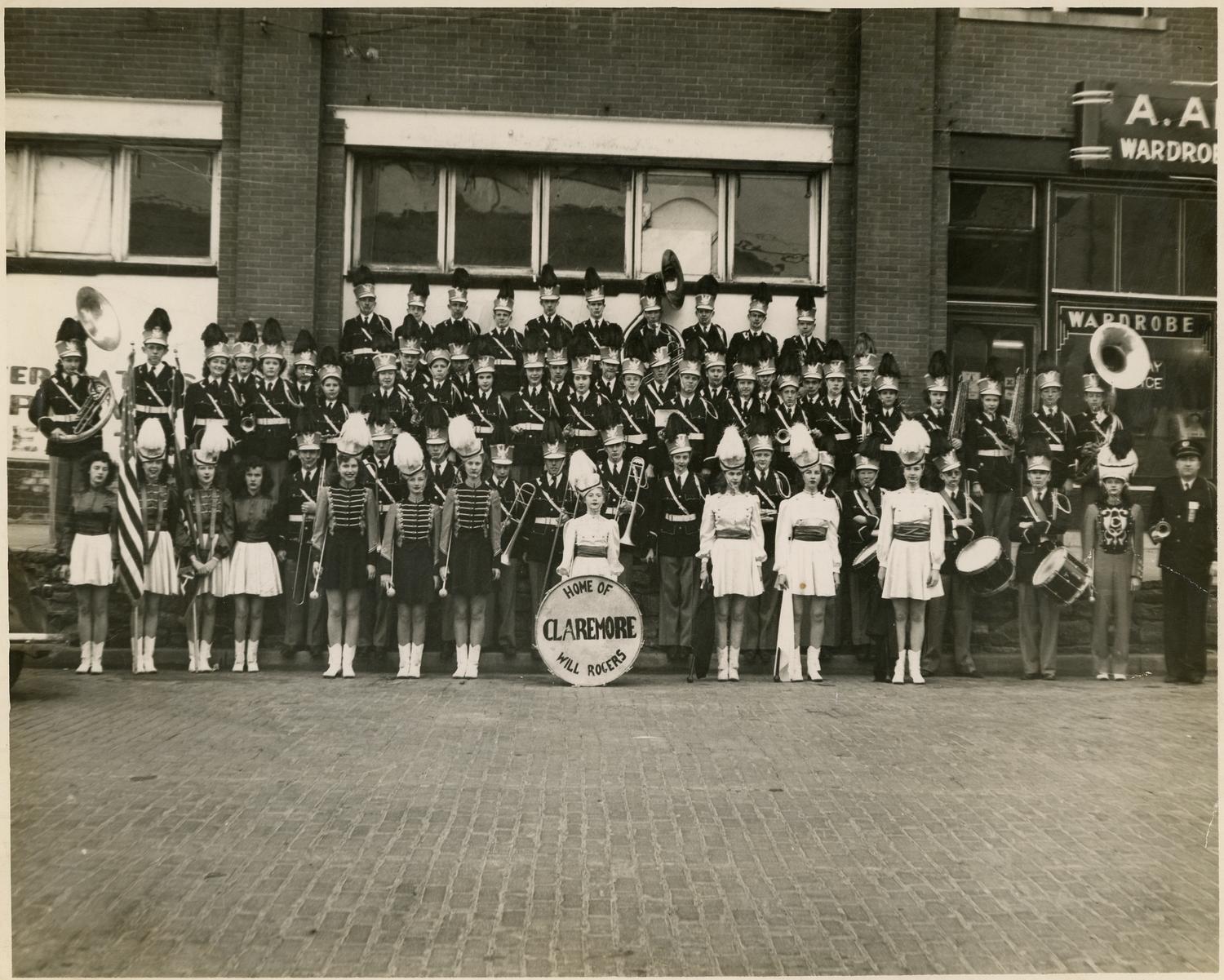
Published-media asset with source attribution retained on the linked record. View the documented record and full attribution.
Band and ensemble inventory
| Ensemble or program | Place | Period supported | Status |
|---|---|---|---|
| Claremore Public School bands | Claremore | at least mid-20th century through 1999 by career evidence | high |
| Justice-Tiawah school band program | Justice-Tiawah | five years under Jerry Lingenfelter, date not stated | high |
| Claremore High School marching band | Claremore | earlier program history confirmed, exact pre-2000 dates not supplied | high/medium |
| Collinsville school band tradition | Collinsville | current and historical lead, pre-2000 details not verified here | low |
| Oologah-Talala school music program | Oologah-Talala | current lead only | low |
Bands and ensembles
Claremore Public Schools
Jerry Lingenfelter taught instrumental music in Claremore for 27 years after returning from Siloam Springs. The museum account specifically connects his work to elementary, junior-high, and high-school students, band festivals, college bowl trips, and Claremore Homecoming parades. (strong evidence)
Justice-Tiawah Public Schools
After retiring, Lingenfelter came out of retirement to begin and lead the Justice-Tiawah band program for five years. The account states that the program earned superior ratings for 18 consecutive years, but it does not establish which portion of that record fell before 2000. (high for the claim, medium for chronology)
Claremore High marching band
The district’s official 2025 article says a 2024 superior rating was only the seventh in program history. That is useful continuity evidence, but no exact founding year or historical director list is supplied. (strong evidence)
Chronology
| Date | Evidence | Confidence |
|---|---|---|
| 1883 | Claremore incorporated under Cherokee law, according to the Rogers County Historical Society. | high |
| 1917 | Claremore Progress and Rogers County Democrat issue available as a digitized local primary source. | high |
| 1935 | Jerry Lingenfelter born in Claremore. | high |
| 1954 | Lingenfelter graduated from Claremore High School. | high |
| 1959 | Lingenfelter married Latricia Ann Voss. | high |
| 1967 | He received an M.A. in Music Education from the University of Tulsa. | high |
| Approx. 1960s-1990s | Lingenfelter taught Claremore elementary, junior-high, and high-school music for 27 years. | high, date range inferred from biography |
| Before 2000, exact years unknown | Claremore bands participated in festivals, college bowl trips, and Homecoming parades under Lingenfelter. | high |
| 1979 | Rogers County History Volume 1 published. | high |
People Index
- Jerry Lingenfelter, Claremore music educator and band leader. (strong evidence)
- Latricia Ann Voss Lingenfelter, spouse and associate in the museum’s preservation account. (strong evidence)
- Courtney Acord, current Claremore High director, not part of the pre-2000 chronology established here. (high for current role)
Directors and bandmasters
Jerry Lingenfelter is the only pre-2000 Rogers County band educator verified in the sources reviewed. He taught Claremore music for 27 years and later founded and led the Justice-Tiawah band program for five years. (strong evidence)
The 1917 newspaper and the 1979 county history are the best sources for identifying earlier directors and additional teachers.
Schools and music education
Claremore Public Schools has high-school, junior-high, elementary, band, choir, and fine-arts infrastructure today, with a historical exhibit at the Claremore Museum of History. The museum’s Lingenfelter account directly supports a long-running Claremore school music program. (strong evidence)
Collinsville, Catoosa, Chelsea, Inola, Oologah-Talala, Verdigris, and Foyil require yearbook-level searches for historical band rosters and directors. Current program pages are not sufficient evidence for the pre-2000 period.
Civic and community bands
No separately named Rogers County municipal or adult community band was verified. Claremore Homecoming marching activity is documented as school-band activity, not a municipal band. (strong evidence)
Military, Veterans, and Fraternal Music
No county-specific pre-2000 military, veterans, fraternal, or American Legion band was verified in the accessible sources reviewed.
African American, Indigenous, and Other Community Music
No qualifying pre-2000 wind, brass, or percussion ensemble in these categories was verified. Claremore’s historical context includes Cherokee and Osage history, but general cultural history was not treated as evidence of an instrumental ensemble.
Women, Girls, and Youth Ensembles
The Claremore school system’s elementary and junior-high music work is directly supported through Lingenfelter’s biography. No separately named girls’ band, women’s band, or youth ensemble roster was verified. (high for school-level youth instruction, low for separate ensembles)
Performances, festivals and public events
Claremore bands under Lingenfelter made trips to band festivals and college bowl games and marched in Claremore Homecoming parades. Justice-Tiawah earned 18 consecutive years of superior ratings, although exact contest dates remain unresolved. (strong evidence)
Venues and Music Infrastructure
The Claremore Museum of History maintains a Claremore Public School fine-arts exhibit and displays Lingenfelter’s trumpet. The museum is therefore both a documented historical venue and a preservation resource. (strong evidence) Museum
The 1917 Claremore newspaper page also documents a district courtroom and fairgrounds infrastructure for county gatherings, but it does not itself prove a band performance at either location. (high for venues, low for music use)
Newspapers and documentary evidence
The Gateway’s Rogers County History Volume 1 is a 495-page 1979 county history. Digitized local newspaper material includes Claremore Progress and Rogers County Democrat, with the 1917 issue identified as a local newspaper primary source. (strong evidence)
Claremore Museum of History also maintains a yearbook gallery and a Claremore Public School exhibit. These are high-priority sources for rosters, photographs, and director names. (high for repository lead) Museum home
Source quality and limitations
The museum biography is a credible institutional secondary source with specific dates, career length, places, activities, and artifact details. The Gateway newspaper and county-history records are primary or near-primary historical sources. Current school pages are authoritative for present programs and useful for continuity, but they should not be used alone to assign a historical founding date.
Historical summary
Rogers County has a verified and meaningful school-band history, especially in Claremore. Jerry Lingenfelter’s career links instruction, marching, festivals, contests, community identity, and preservation across multiple generations. The county’s broader band history is not yet complete, but the combination of the Claremore museum, county history, and digitized newspapers gives this county a strong foundation for deeper documentation.
Uncertain or not found
The exact founding date of the Claremore High band, the full list of pre-2000 Claremore directors, the exact years of Lingenfelter’s 27-year Claremore service, the dates behind Justice-Tiawah’s 18 consecutive superior ratings, complete rosters, and verified pre-2000 band records for most smaller county communities were not found.
Photographs, clippings and documentary evidence
Photographs and documents
The Claremore Museum of History article includes an image associated with Lingenfelter and documents a physical display containing his trumpet. The article does not provide a complete historical band photograph or roster. (high for artifact evidence, medium for image reuse)
The 1979 county history is a priority for photographs, school portraits, and community images.
Sources and evidence
Links and citations below come from the underlying county research. Repository descriptions and access conditions remain controlling for reuse.
Selected Sources
What remains unknown
Negative Searches and Archive Gaps
No pre-2000 named adult community band, municipal band, military band, veterans band, fraternal band, separate girls’ band, complete roster, or historical photograph was verified outside the Claremore school evidence. Collinsville, Catoosa, Chelsea, Inola, Oologah, Verdigris, and Foyil remain incompletely searched at page level.
The largest gaps are earlier Claremore directors, exact band founding dates, annual contest results, school-yearbook rosters, and newspaper evidence after 1917.
Related records
Historical evidence documents activity found in the sources; it does not by itself prove continuous operation. Similar names are not merged unless continuity is supported.